RoboAarambh Is Redefining STEM Education in Nepal, One Classroom at a Time
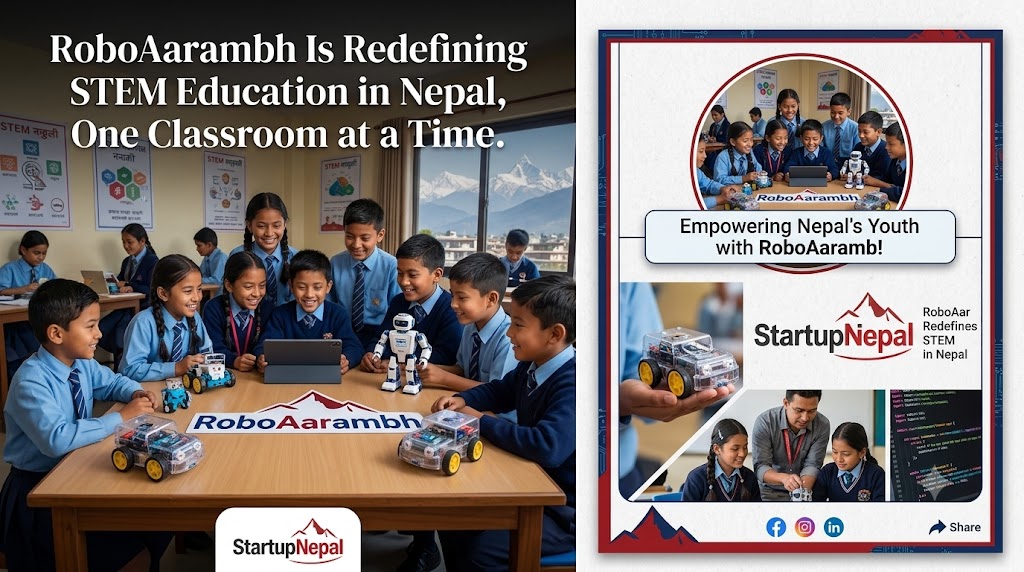
How a Kathmandu-based robotics startup is helping Nepali schools move students from being technology “users” to technology “builders.”
For decades, science and math education in Nepali schools has leaned heavily on memorization: formulas copied off a blackboard, diagrams traced from a textbook, and exams that reward recall over reasoning. RoboAarambh, a Kathmandu-based robotics and STEM education company, is trying to change that story — one robotics lab, one teacher training, and one curious student at a time.
Who Is RoboAarambh?
RoboAarambh is a Nepali edtech company focused on bringing hands-on robotics, coding, Artificial Intelligence (AI), and Internet of Things (IoT) education into schools across the country. Rather than treating technology as a subject to be studied in theory, RoboAarambh builds practical, project-based learning experiences that let students design, build, and program real devices, from simple circuits to working robots.
The company’s mission fits into a much bigger conversation happening in Nepal’s education sector right now: how do we prepare a generation of students for a world driven by automation, AI, and digital innovation, when much of the current system was designed for an industrial-era workforce?
The “Hamro Robotics School” Initiative
RoboAarambh’s flagship program, Hamro Robotics School, is a good example of what this shift looks like in practice. The initiative aims to weave robotics, STEM, AI, and IoT directly into the school curriculum, with the goal of preparing students for the demands of a modern, global workforce.
At its launch event in Kathmandu, the program brought together more than 45 headteachers and educators representing over 30 schools, alongside industry experts, to explore how technology-driven learning can close the gap between traditional classroom instruction and the skills industries actually need today. It’s a signal that RoboAarambh isn’t just selling robotics kits, it’s trying to build a movement among school leaders themselves.
Teaching the “4Cs,” Not Just Circuits
A central idea behind RoboAarambh’s approach is what’s often called the “4C” framework: Creativity, Critical Thinking, Collaboration, and Communication. These are the soft skills employers consistently say are missing in new graduates, not because students lack intelligence, but because rote-learning systems rarely give them room to practice creating, questioning, or working in teams.
By having students physically build hydraulic lifts, periscopes, simple game circuits, and other hands-on STEM kits, RoboAarambh turns abstract science concepts into tangible, testable projects. A student who builds a working periscope understands the physics of light reflection far more deeply than one who only reads about it. A team debugging a malfunctioning circuit learns patience, logic, and collaboration simultaneously, skills no textbook chapter can fully teach.
As RoboAarambh’s leadership has put it, the goal is to move students from being passive users of technology to active builders of it, a subtle but important distinction for a country that imports the vast majority of its consumer technology but has enormous untapped potential to produce its own.
Why This Matters for Nepal
Nepal’s education system has made real strides in access and literacy over the past two decades, but employers, particularly in tech, manufacturing, and engineering, continue to report a mismatch between what graduates learn and what jobs actually require. Robotics and STEM education addresses this gap in a few concrete ways:
- Early exposure builds confidence. Students who encounter coding, electronics, and robotics in school (rather than for the first time in university or on the job) are far more likely to pursue STEM careers with confidence.
- Hands-on learning improves retention. Educational research consistently shows that project-based, experiential learning leads to deeper and longer-lasting understanding than passive memorization.
- It aligns school education with industry standards, helping ensure Nepali graduates are equipped to compete not just locally, but globally, as automation and AI reshape entire industries.
- It supports Nepal’s broader development goals, connecting classroom learning to national priorities like green technology, sustainable innovation, and Technical and Vocational Education and Training (TVET).
At a time when countries around the world are racing to integrate AI and robotics literacy into K-12 education, initiatives like RoboAarambh’s help ensure Nepal isn’t left behind.
Bridging Schools, Teachers, and Industry
One of the more distinctive aspects of RoboAarambh’s approach is its emphasis on teacher training, not just student workshops. Equipping a classroom with robotics kits does little good if teachers themselves aren’t confident using and teaching the technology. By training educators alongside students, RoboAarambh is building sustainable capacity inside schools — capacity that outlasts any single workshop or event.
The company has also brought in academic and industry voices to reinforce this bridge. At the Hamro Robotics School launch, technology experts spoke about the intersection of AI, robotics, and green technical education, framing school-level STEM learning as the essential link between basic education and university- or industry-readiness.
What’s Next for RoboAarambh
With its website now live and its flagship school program expanding across the Kathmandu Valley and beyond, RoboAarambh appears to be positioning itself as a long-term infrastructure partner for Nepali schools — not a one-time workshop provider. For a country where access to quality STEM resources has historically been concentrated in a handful of urban private schools, that ambition matters.
If RoboAarambh succeeds in scaling its model to public and community schools, the impact could extend well beyond robotics clubs and science fairs. It could help shift how an entire generation of Nepali students relates to technology, not as something that happens to them, but as something they have the tools to create.
Learn more about RoboAarambh’s programs at roboaarambh.com.
This article is part of TheStartupNepal.com’s ongoing coverage of Nepali startups reshaping education, technology, and entrepreneurship.