Startup Loan 2083/84: What to Prepare Before IEDI’s Call Opens
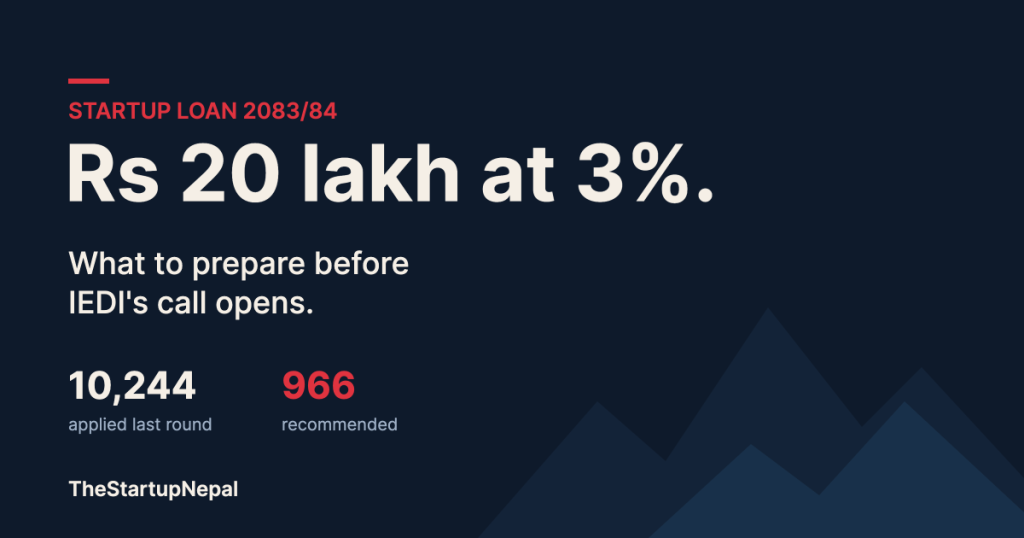
More than 10,000 people applied for a startup loan last round. 966 got a yes.
The government’s startup enterprise loan is the cheapest money most Nepali founders will ever be offered: up to Rs 20 lakh at 3 percent, with no land or house as collateral. It is also a numbers game with a short window. When the Industrial Enterprise Development Institute (IEDI) opens its call, applicants get 21 days. The founders who do well are the ones who were ready before the notice dropped.
Here is what the scheme offers, who qualifies, how selection worked last time, and what to get in order now.
The short version
| Last round (FY 2082/83) | |
|---|---|
| Loan size | Rs 5 lakh to Rs 20 lakh (cut from Rs 25 lakh) |
| Interest | 3% a year |
| Collateral | None. The project is the security, backed by the Deposit and Credit Guarantee Fund |
| Lender | Rastriya Banijya Bank |
| Bank service fee | Up to 0.1% of the loan |
| Application window | 21 days from IEDI’s public notice |
| Applications | 10,244 |
| Recommended for loans | 966 |
Sources: Kathmandu Post, Kantipur.
Who qualifies
Under last year’s procedure, your business needed to be:
- Registered as a private firm, partnership, company or cooperative.
- Registered before the call for proposals was published, and no more than 10 years old.
- Below Rs 15 crore in annual turnover in every year since registration.
- A new business, not a branch, merger, split or continuation of an existing one.
- Built on an innovative or creative approach, with real room to grow.
Eligible sectors were broad: agriculture and livestock, forestry, tourism and hospitality, IT and communications, health, education, food processing, transport and more (Kantipur).
Who doesn’t
- Businesses that import and distribute goods or services.
- Blacklisted businesses.
- Holding or investment companies under the Industrial Enterprise Act, 2076.
- Anyone who took a government concessional loan before and hasn’t repaid it (Onlinekhabar, Onlinekhabar Nepali).
The registration rule catches people every year. If you are still “planning to register,” do it now. A company registered after the notice is out does not count.
How selection actually worked
Last round looked like this:
- 10,244 proposals came in, about 80 percent of them online.
- 1,301 made the preliminary list.
- Shortlisted applicants were asked for extra business details. Local government enterprise development units sent in photos and videos of the business, and physical inspections were added after fake videos turned up in earlier rounds.
- 1,156 presented to the committee.
- A committee score was combined with the bank’s own credit appraisal. Only proposals scoring at least 50 percent went forward, best scores first.
- 966 were recommended and told to reach their bank branch within three days (Kathmandu Post, Kantipur).
Two lessons from that funnel. First, the bank’s view counts, not just the committee’s. Your numbers need to look like a business a banker would lend to. Second, the process is slow. The call opened in November 2025 and recommendations came out in July 2026, partly because of the elections. Recommendations that weren’t acted on lapsed at the end of Asar.
What to prepare now
The documents asked for at the bank stage last round give you a good checklist (Onlinekhabar Nepali):
- Business registration certificate, renewed and up to date
- PAN/VAT registration certificate
- Tax clearance for the latest fiscal year (file now if you haven’t)
- Citizenship certificate of the authorised person
- Passport-size photo of the authorised person
- Recent financial statements, even simple ones
- Photos and a short video of your actual operation
- A draft project proposal you can drop into IEDI’s format
Writing a proposal that survives the funnel
- Say what is new, in one sentence. “Innovative” is a requirement, so spell out what you do differently from the shop next door.
- Show the money honestly. The bank appraises you too. Use realistic sales, real costs and a repayment plan that works at 3 percent.
- Count the jobs. How many people you employ now, and how many the loan adds.
- Match the amount to the plan. Asking for the full Rs 20 lakh with a plan that needs Rs 8 lakh reads badly.
- Don’t fake the field evidence. Inspections exist because some people did.
When will the call open?
IEDI hasn’t announced the 2083/84 call yet. The last two calls came in Bhadra 2081 (August 2024) and Kartik 19, 2082 (November 5, 2025) (Ratopati). In May, the industry ministry proposed Rs 1.15 billion for startup loans this fiscal year. If the pattern holds, the notice could come any week now. We’ll post it the day it’s out.
Is it worth it?
For a small production or service business, yes. Money at 3 percent with no land as collateral is hard to beat in Nepal.
For a tech startup, be clear-eyed. Rs 20 lakh is a few months of a small team’s salaries. Most selected businesses last round were SMEs with a bit of innovation: spices, noodles, beekeeping, banquets (Kathmandu Post). It is also a loan, so you’ll owe repayments and quarterly progress reports whether or not the product works out.
Applying this round? Tell us what’s tripping you up, and we’ll answer the common questions in a follow-up.